



Beverly Market Activity June 2026
The Beverly Ridge Rises: Why Chicago’s Architectural Enclave Just Witnessed a 42% Price Surge
1. Introduction: The Quiet Neighborhood with Loud Numbers
Beverly has long been celebrated as one of Chicago’s most storied residential enclaves—a place where the city’s only "rolling hills" meet an unparalleled architectural footprint. For those who walk its tree-lined streets, Beverly, East Beverly, and West Beverly typically project an air of historic tranquility and deep-rooted community. However, the latest market activity report released in June 2026 by Maurice Hampton of Centered International Realty Corp reveals a narrative that is anything but quiet.
The data for April 2026 shows a neighborhood in the midst of a radical competitive transition. While Beverly’s aesthetic remains timeless, its real estate metrics have turned explosive. For sophisticated observers of the Chicago market, the shift is undeniable: this historic pocket is currently hosting some of the most aggressive bidding environments in the city.
2. The 42% Surprise: A Median Price Explosion
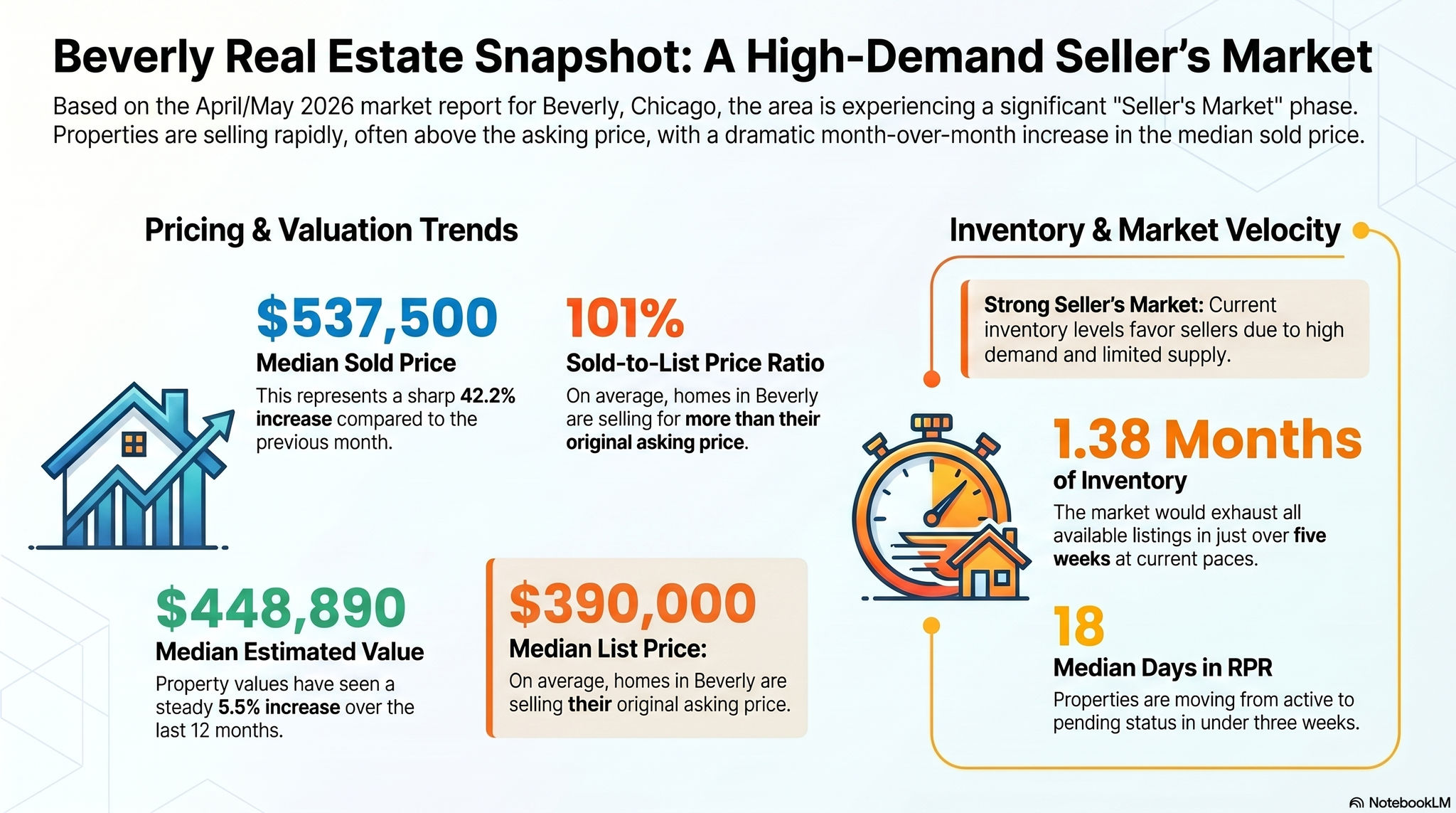
The most staggering figure in the April 2026 report is the Median Sold Price, which soared to $537,500. This represents a massive 42.2% increase month-over-month. To appreciate the magnitude of this jump, one must contrast it with the "Median Estimated Property Value," which saw a far more modest rise of just 2.1% during the same period.
This divergence signals that the ground-level heat of the market is moving significantly faster than standard valuation algorithms can track. It serves as a potent reminder that digital models often struggle to capture the emotional premium of a high-demand architectural enclave. As noted in the report:
"Estimated property values are generated by a valuation model and are not formal appraisals."
In the current climate of the Ridge, the reality at the closing table is far outpacing the predictions of the software.
3. The $90,000 Gap: Expectations vs. Reality
There is currently a fascinating nearly 90,000 discrepancy between "expected" value and actual market performance. The Median Estimated Property Value sits at **448,890**, yet homes are trading at a median of $537,500.
Crucially, this is not a case of sellers overreaching with ambitious "pie-in-the-sky" asking prices. According to data from Maurice Hampton’s report, the Median List Price for new April listings was $449,900—almost identical to the estimated property values. This reveals a vital market insight: sellers and valuation models are perfectly aligned on what these homes should be worth. The surge is being driven entirely at the offer table. Buyers are intentionally and aggressively ignoring list prices to reset the ceiling of what this historic footprint demands.
4. Over the Asking Price: The 101% Standard
In a typical balanced market, the "Sold to List Price %" usually hovers slightly below 100% as buyers negotiate downward. In Beverly, the standard experience has flipped. The ratio currently stands at 101%.
While a 1% premium might seem marginal to a casual observer, in the world of real estate investment, a neighborhood-wide median above 100% is a siren of intense competition. In a market with a mere 1.38 months of inventory, the "list price" has effectively ceased to be an asking price; it has become a starting bid. For the modern Beverly buyer, entering the fray means preparing for a scenario where the sticker price is merely the opening suggestion.
5. Racing the Clock: 18 Days to Under Contract
Efficiency is the hallmark of the current Beverly market. The "Median Days in RPR"—the time a property spends on the market before going under contract—is currently just 18 days.
While this represents a 260% increase from the previous month (indicating that March was moving at an almost instantaneous pace), 18 days remains exceptionally fast for a complex real estate transaction. For buyers, the "decision window" has narrowed to a sliver. You no longer have the luxury of multiple weekends to weigh your options; in Beverly’s current state, if you find a property that fits your lifestyle, you likely have less than three weeks before a contract is signed and the opportunity vanishes.
6. The Inventory Squeeze: Living in a Seller’s Market
The data confirms that we are firmly entrenched in a "Seller’s Market," dictated by a severe inventory squeeze. The 1.38 months of inventory tells the story of a market with almost no "shelf life."
The Centered International Realty report provides a clear definition of this high-stakes dynamic:
"Months of inventory is the number of months it will take a market to absorb the inventory that's available at the end of the month, based on the number of properties that typically go into pending each month."
With supply failing to reach even a month and a half, the leverage sits entirely with those holding the keys. Demand for the Beverly lifestyle is simply outstripping the available stock, turning every new listing into a high-demand commodity.
7. Conclusion: What’s Next for Beverly?
While the 42.2% monthly price spike is the headline of the moment, it is important to ground this volatility in Beverly's long-term trajectory. Looking at the 12-month change in estimated value, we see a steady, healthy growth of 5.5%. This suggests that while April was a month of extraordinary peaks, the neighborhood remains a bastion of reliable appreciation.
As we move through 2026, the question for residents and investors alike is whether this $537,500 median is a temporary result of a few high-end sales or the "new baseline" for one of Chicago’s most prestigious communities. One thing is certain: Beverly is no longer a hidden gem. It is now a primary stage for the city’s most competitive real estate drama.
Check out this article next